
 Image 1 of 1
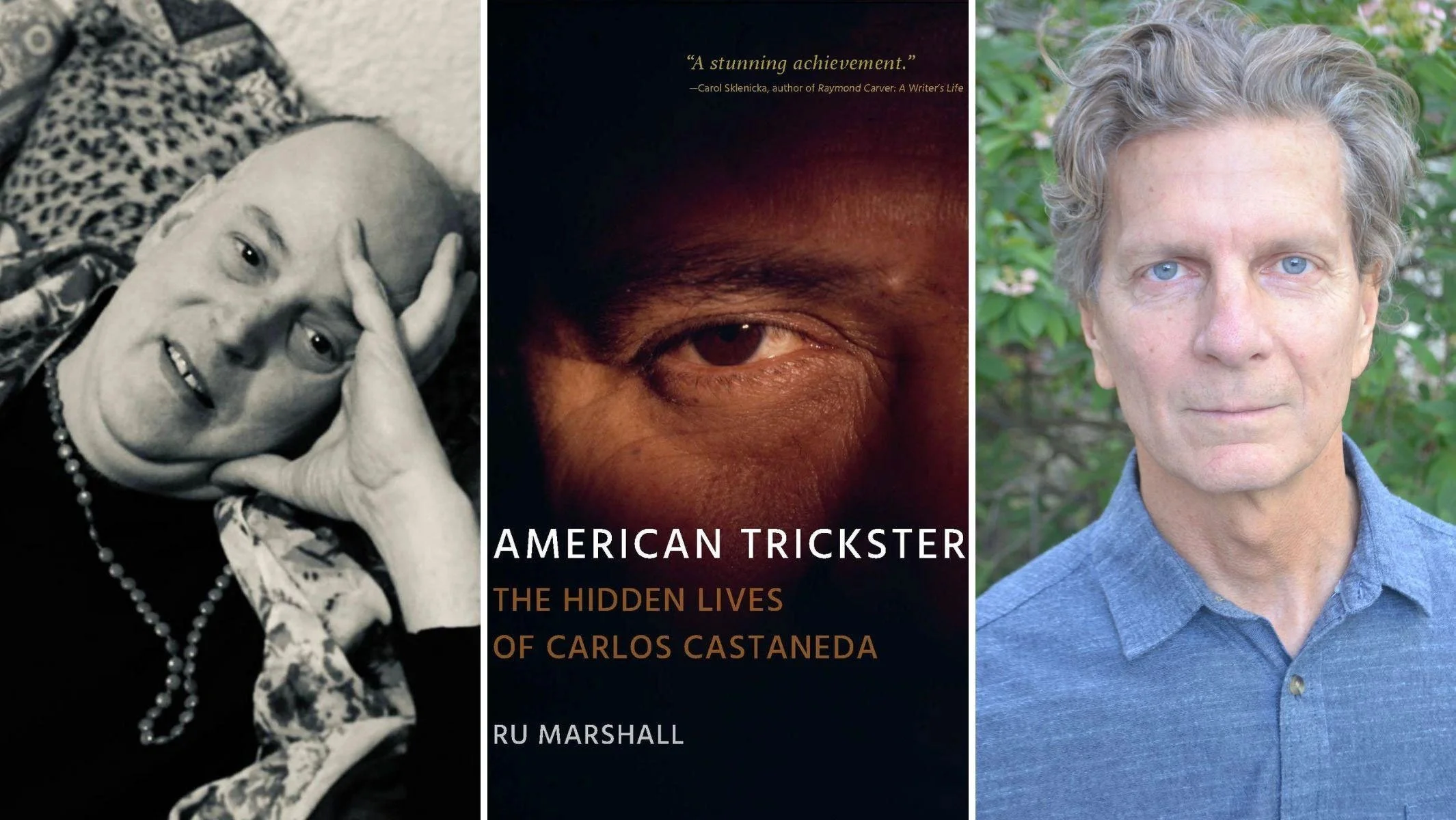
Twenty years in the making, American Trickster: The Hidden Lives of Carlos Castaneda unravels the story of the secretive faux-anthropologist who pulled off one of the greatest literary hoaxes in modern history. Both an investigation of the techniques employed by charismatic narcissists and a study of the cult dynamics that still shape American life, American Trickster defies conventional biography. It emerges as a chilling allegory for the Trump era, a trenchant critique of academia’s complicity in distorting and erasing Indigenous culture, and a deep dive into the mechanics of New Age spiritual abuse.
Carlos Castaneda, born in Peru in 1925, fled to the U.S. in 1951, escaping responsibility for a child he fathered with a thirteen-year-old girl. He changed his name repeatedly, worked as a taxi driver, studied creative writing, and eventually enrolled in anthropology at UCLA in 1959. In 1968, the University of California Press published his first book, The Teachings of Don Juan, which described his supposed encounters with a Yaqui shaman who initiated him into a secret world of peyote-fueled visions and ancient knowledge never before shared with a “Westerner.”
Castaneda was quickly hailed as a revolutionary figure. Admirers ranged from John Lennon and Joni Mitchell to Federico Fellini, George Lucas, and Octavio Paz. His books became international bestsellers and remain the most popular titles ever published on Native American spirituality―despite having little to no connection to actual Indigenous practices.
For a time, his truth went unchallenged. Then, in 1973, Time magazine published a searing exposé revealing that Castaneda wasn’t who he claimed to be. As his academic credibility unraveled, he turned inward, building a secretive spiritual group that blurred the line between fiction and reality. Castaneda’s followers, mostly women, became living extensions of the characters in his books―devoted disciples who often abandoned their former lives entirely.
By the 1990s, as book sales declined, the group emerged publicly, offering workshops and seminars to thousands across the globe. When Castaneda was diagnosed with liver cancer, he told his disciples he would not die, but burn from within and ascend to another realm―and invited them to join him. After his death in 1998, five of his closest female followers vanished. They are widely believed to have taken their own lives.
Ru Marshall is a nonbinary writer and visual artist. Their novel, A Separate Reality, was released by Carroll & Graf in 2006 and was nominated for a Lambda Award for debut fiction. Their writing has appeared in Salon, N + 1, The Evergreen Review, and many other publications. They have twice been nominated for a Pushcart Prize and received the 2016 Hazel Rowley Prize from BIO, the Biographers International Organization. Their visual work has been exhibited at Participant Inc., Art in General and White Columns. They have received grants and fellowships from MacDowell, Yaddo and The Virginia Center for the Creative Arts.
Thad Ziolkowski is the author of Our Son the Arson (What Books, 1996), a collection of poems, the memoir On a Wave (Grove/Atlantic, 2002), which was a finalist for the PEN/Martha Albrand Award in 2003, and Wichita (Europa, 2012), a novel. His most recent book, The Drop: How the Most Addictive Sport Can Help Us Understand Addiction and Recovery, was published by HarperCollins in 2021. His essays and reviews have appeared in The New York Times, Slate, Bookforum, Artforum, 4Columns, Galerie and Interview Magazine. He is the recipient of a Guggenheim Fellowship. He has a Ph.D. in English Literature from Yale University.